Here is a tutorial from Stephanie at The Enchanting Rose on how to make a super easy tissue holder from a vintage handkerchief. You could also use just a piece of fabric of your choice. I love vintage handkerchiefs, but I don't want the bother of washing them, so I don't use them. This is a very appropriate way to upcycle one, I think. :-)
Hello and welcome!
Friday, April 27, 2018
Sew Happy Friday - Tutorial for A Tissue Holder
Here is a tutorial from Stephanie at The Enchanting Rose on how to make a super easy tissue holder from a vintage handkerchief. You could also use just a piece of fabric of your choice. I love vintage handkerchiefs, but I don't want the bother of washing them, so I don't use them. This is a very appropriate way to upcycle one, I think. :-)
Friday, December 4, 2015
How Polyester Is Made
Last Friday we learned how Polyester Fleece is made. This week we’re learning how polyester fabric itself is made from plastic bottles. Polyester becomes many things besides fleece. Some of them are used often in sewing and crafts. It is mixed with cotton in some fabrics to reduce wrinkling. It is made into a number of other types of fabrics as well. It is made into threads and yarns of various types.
Did you know that some people are intolerant of wearing polyester on their skin? I am one of them. I can wear it only in limited amounts. My dad used to tune pianos and he had a customer who told the horrible story of how his wife developed a terrible intolerance or allergy to polyester after wearing in constantly for some years. Her whole body broke out in a bad rash and it really affected her health. At the time my dad met them she was having to wear only clothing made from all natural fibers. Recycling plastic is a worthy cause, but the fibers God created are the best after all is said and done. :-)
Friday, November 27, 2015
How Fleece Is Made
Here’s an interesting video that explains how fleece is made. Did you know that it is partly recycled bottles? :-)
Next Friday we’ll find out how they make the polyester from plastic bottles! :-)
Friday, January 23, 2015
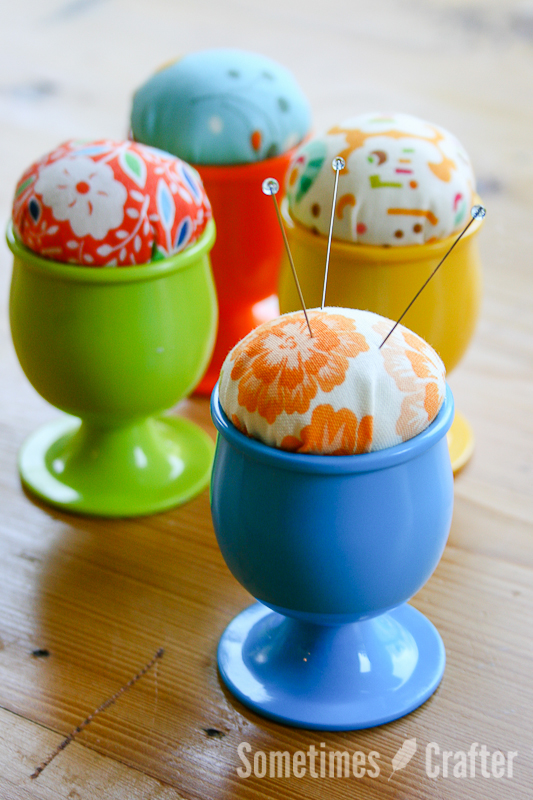
Sew Happy Friday – Egg Cup Pincushions

Photo property of Christina Lane of the Sometimes Crafter blog.
Here’s a clever way to up-cycle your unused egg cups, or ones that maybe have a hairline crack or internal damage. I don’t have any egg cups on hand at the moment, but as I sort through our garage (I think the stuff is multiplying and dividing out there) I may run across one or two. This is another opportunity to “shop your own stuff” and to use up scraps of fabric. (I’m wondering if I could figure out a way to use some cute little china napkin rings for this purpose.)
Here’s the tutorial from Christina Lane at the “Sometime Crafter” blog.
Enjoy!
Sunday, October 13, 2013
Hard Questions – Who Is Polluting the Environment?
Isaiah 55:8 For my thoughts are not your thoughts, neither are your ways my ways, saith the LORD. 9 For as the heavens are higher than the earth, so are my ways higher than your ways, and my thoughts than your thoughts.
The Problem
There are a lot of people who are all worked up about pollution (of the earth and in food sources), global warming, endangered "species", and so on. Because almost all of them start with an evolutionary perspective, and some with a "mother earth" religious view, they miss the root cause of the problems and so cannot offer a truly useful solution.
Now it's true that some of their "problems" are highly exaggerated or not even real. Some of them are genuine, though, and sometimes they have been able to bring about changes that improve the situation. The Industrial Revolution was marked by rampant polluting in Europe and America, which generated dangerous smog, waterways, etc. This has been true at other times and places as well. Some of these messes have been cleaned up remarkably; but it's a curious thing that for all the progress that is made, on a regular basis some new and horrible polluting or abuse of God's creation comes to light.
Saturday, April 27, 2013
Sew Happy Saturday – Vintage Handwork Recycled Into An Apron
Here is a cute little apron that a friend of mine has hanging in her kitchen.

This apron was made using a vintage embroidered dresser scarf/table runner that had been spoiled by at least one stain. The lady who made this cut the dresser scarf up, pieced it together avoiding or covering the stains, added a few embellishments (crocheted butterflies – which might be covering spots), and added ties. Isn’t it a cute way to use up an old marred piece? Really the embroidery on it is too beautiful to throw away, so this was a great way to recycle it. My friend thought it too pretty to wear, so she made this sweet arrangement including a vintage crocheted potholder, a wooden spoon, and an old family recipe for biscuits. :-)
Do you have a piece of vintage embroidery or handwork that has been marred with a stain? Maybe you could figure out a way to transform it into something “new”. It’s a great way to shop your own stuff. I have an old pillowcase with some lovely embroidery along the edge that I’d like to recycle into another project – a sofa cushion cover, worked into a quilt or garment…something. If I get it done I’ll try to remember to post about it. :-)
Wednesday, August 15, 2012
Shop Your Own Stuff – Bringing the Outside In
If you’ve read the previous posts in this series, you know that I am making an effort to inspire myself and others to “shop your own stuff” instead of always thinking that buying is the solution. It is a challenge to improvise and think outside the box a bit. In this post I’m really talking about thinking outside – as in going outdoors to “shop” for things. :-)

Of course, fresh garden flowers, fruit and vegetables are obvious ways to “decorate” by bringing the outside in.

My sister-in-law made an interesting bookend out of a piece of limestone she found. She intends to find another one so she can have two “matching” limestone bookends. :-) (We have lots of limestone on our property here in central Texas!) To do this it’s recommended to clean off excess dirt, bake the stone to kill any critters and, if you’re placing it directly on a wood surface, you may want to place a piece of felt or thick cloth under it or attach self-sticking felt pieces on the bottom. As you can see in the photo, my sister-in-law tacked a throw to the wall behind the books and rock, folded it down to protect the top of the bookshelf, then ran it behind the shelves to protect the wall as well.

Rocks also make great door stops. An addition of felt may again be needed to protect you floor. If you want something colorful, paint it with an interesting design. Use your God-given creativity.
More ideas for shopping the outdoors – 
Use larger shallow seashells for soap or candy dishes.
A piece of drift wood becomes a coat and hat rack when attached to the wall and with hooks added. My dad went to a sawmill once and got a number of the outside cuts of wood – the pieces with the bark still on them. I don’t recall what they charged him, but it was scrap, so it wasn’t much. He selected trees that didn’t have extremely rough bark. He used these to cover the open area by a stairway to make it safe for small children. He screwed the pieces on with the bark side out toward the lower hall and the cut side in towards the stairs. Then he screwed hooks into each piece on the bark side to make a long row of coat hooks (something very useful in northern climates, especially if you have large groups in your home regularly). I wish I had a picture of it; it was a very unique and interesting solution to two needs.
You can make all kinds of art out of driftwood as well.
If you need bookshelves and you have a pile of old bricks or cinder blocks (see number 2 on this page), you may be able to work them into something useful with some leftover shelves or wood planks. It’s important in this project to use wood that is sturdy enough to bear the weight of books, and also that it not be cut in long pieces, unless you add extra supports in the middle. Paint, contact paper, leftover wall paper, and even fabric “skirts” can dress these shelves (and bricks) up and make them more presentable if you don’t like the “rustic” look. :-)
For décor, don’t forget the flowers. There are a number of flowers that can be dried to make attractive floral displays, making your flower garden do double duty for you. They can make a nice alternative to buying artificial flowers. There are several ways to dry them, including pressing them for various flat art. I’ve even spray painted the centers of Echinacea (purple cone flowers). I used them once in the rich brown they were to start with (petals removed), and then later when they got kind of dusty, I cleaned them off (use a soft, dry paint brush), spray painted them gold and used them again. :-) I had a friend who collected and dried pepper grass from near their house, painted it with red, white and blue spray paints, and made some really pretty little arrangements for her country style kitchen. Hydrangeas make an interesting and somewhat impressive dried flowers. Strawflowers (pictured above) are, in my opinion, one of the easiest flowers to grow for dried flowers, and they are so colorful both in the garden and dried.
Of course, autumn foliage can make lovely decorations too in areas that have the vibrant color changes. Two comments regarding this link: 1. Be sure to put water in the vase when using cut fall foliage otherwise it will wilt or shrivel. 2. Dream catchers are an instrument of American Indian spiritism and we do not recommend using them in any shape or form.

There are many ways to use pressed leaves, pinecones, seed pods and acorns. For using acorns or other nuts for décor, I recommend baking them at a low temperature (150F) for 45 minutes to kill critters inside. Just don’t let them burn. If you don’t do this those critters may eventually decide to come out and your décor may be ruined or marred.
I had a friend whose family had lived in the same area where she lived for many years. She found the old spot where they had dumped their trash and garbage years and years ago. She rescued some brightly colored old glass bottles and possibly some other artifacts to use in her décor. It added some nostalgia along with it in that case. :-)
What other ideas can you come up with? Challenge yourself to think of ways to “shop” outside. You might be surprised at what you find. (Note: Do make sure you’re allowed to carry things away from the area where you’re “shopping” if it’s not your own property. For example: National Parks and historic areas may not allow you to carry things away – even rocks.)
Tuesday, June 19, 2012
Shop Your Own Stuff – Storage and Organizing Potential
If you read the previous post in this series, you will remember that I’ve been challenging us to “shop our own stuff” more instead of buying something every time we have a need, or imagine that we do. These suggestions are things that I’d already done, but they show the possibilities.
------------------
Repurposing things has been a habit in my family for years. My dad was especially proficient at it. I still remember his overhead storage area for screws, nails, washers and various small bits. He took a lot of baby food jars (which were available in our home at that time) and screwed the lids to a board, leaving enough room to grab the jars. Then he attached the board to the ceiling of our pantry/storage area, filled the jars with the small items and screwed them to the lids. If you needed something in that line, all you had to do was look up and you could quickly see which jar you needed, unscrew it and retrieve you items. It was a clever storage solution, and out of reach of little hands. :-)

Mugs make great pen and pencil holders. We have more mugs than we need, so I have several serving this purpose now. They not only keep things in one spot, they have a built-in, easy relocation system. If you are concerned about sharp or heavy objects (such as scissors) hitting the bottom and breaking the mug, simply trace the bottom of the mug onto one or two pieces of craft foam or cardboard. Cut inside the lines, then trim the circles down to fit the bottom of the mug to reduce the risk of breakage.
By the way, this is something that was a result of the “Get Rid of Fifty Things” challenge. Not only did I get a mug out of our crowded cupboard, but I also got rid of a tin can that I had long been intending to cover with fabric or contact paper. The mug looks nice, and using it saved me from covering the can – so I abandoned an unnecessary project too. :-)

An extra large Altoids® tin makes a great holder for paper and pencils in the game drawer. You could repurpose some other type candy box.

(A good idea if you live where there are spiders or scorpions – keep garden gloves in a sealed plastic bag or jar. That way when you go to put them on you can be sure they are critter-free.)

Plastic containers (a lot of these came from peanuts and pretzels purchased in bulk), can be repurposed for organizing and storage instead of buying a lot of “perfect” boxes ($$$) like the professional decorators/organizers do. In certain situations I do buy containers because this method wouldn’t work, but in the above situations it was fine.

An old suitcase or trunk, with or without a coat of paint, can serve as decorative storage, or even a coffee table. We use an old trunk of my grandparents’ as our coffee table/foot-rest/sometimes-seat and it also stores most of our games and puzzles. My brother and sister-in-law did the same thing with a newer trunk of theirs (pictured above). The great thing about this is you don’t have to worry about bangs and bumps from the kiddoes’ toys or adults’ shoes because it’s already “rustic”. ;-)
I bought this popcorn tin on clearance, but you may have one left from a holiday gift. I use mine to store the garbage bags right next to the kitchen bin so it’s quick and easy to reline it, but looks nice at the same time. It would work well for other storage purposes also – maybe cookie cutters or canning supplies.
You can also reuse tins like this to make gift “baskets” or to pass on food gifts to others. Just be sure to put the food in food safe bags or containers.
Hopefully this gives you some more ideas of ways to shop your own things. I hope you enjoy the challenge and the opportunity to be inventive with me. :-)
Tuesday, June 12, 2012
Shop Your Own Stuff – Another Perspective On Repurposing, Recycling and Saving Money
[Please see more links for this series below the article.]
This series is a off-shoot of the Laying Aside Weights series that I’m running this year. The last post in that series was a little heavy, so I wanted to do something lighter this week. :-)
In an effort to rethink and reorganize some things, I “stumbled” across this idea and it inspired me. I hope you like it as well.
My husband and I have a garage full of stuff. Some of it belongs to us. Some of it belongs to my brother and sister-in-law who live next door. Much of it belongs to my parents who downsized a few years ago and also live next door to us. Some of it belonged to my grandparents who are now with the Lord. And, amazingly enough, even my brother in Australia has stuff stored in our garage. Yeah, I know. What? [That last one is a long story, which partly involved his marrying an Aussie and leaving the U.S. on relatively short notice, presumably to be followed later by his stuff. But, life plays funny tricks on us all sometimes and the stuff is still here, though he’s long since settled over there. :-) And, yes, I do have a plan in mind for working on this, at least to some degree.]
Anyway, you get the picture. We have a lot of stuff out there. Some of it is obviously not up for grabs, but between our stuff and my parents’ “leftovers” and my grandparents’ “left-behinds” there is quite a lot of potential. My local sister-in-law has observed that digging through stuff out there is like opening gifts, and I think she has mentioned that it’s like going shopping. It’s true too.
Awhile back I saw a blog post somewhere in cyber space, in which the author suggested the concept of “shopping our own stuff”. She wanted a better furniture arrangement for their bedroom, and in looking around her own home realized she had a perfect solution in a dresser that her son was leaving behind when he left for college. With a little TLC it suited her purpose exactly and cost her little to nothing, whereas a new or even used dresser would have meant spending money.
As you may know, I like to repurpose and recycle things (in the old sense of recycle, not the modern “save the earth” fad). I also like “cheap” solutions – sometimes to my husband’s pleasure and sometimes to his chagrin. Ahem. Consequently, this lady’s experience and the memory of my sister-in-law’s comments have inspired me to not only continue something I was already doing, but to challenge myself to see what we already have that I could “make do” in place of buying something – to “shop our own stuff”. :-) I admit, I have room to improve; however, I have found it not only to be a money saver, but also entertaining and challenging to my thinking.
And, somehow I also feel that it’s in keeping with 1 Corinthians 7:31, And they that use this world, as not abusing it: for the fashion of this world passeth away. Sometimes I think we Christians abuse our abilities in this world by running after things in the same fashion that this world tends to do, rather than working within the means God has given us in the things we already have at hand.
I’ve been working on a corner of our living room in particular and have made a little progress that I’m happy about. I intend to share that with you at some point (when it’s more finished), but for today I want to pass on some other ideas which may help you get interested in this too.
First off, this is something that I hope to do in our dining room. We have an eclectic mix of blue and white dinnerware, and since I have some quite pretty blue and white collector plates, I was thinking that, whenever I can lay my hands on them again (yeah, they’re lost in the garage, I mean “store”), I’d like to use them like this - Plates as wall art. I also have two or three plates that would look quite pretty in the bedroom. Yes, why not think a little outside the box while we’re at it? :-) I found plate hangers at Amazon.com and they weren’t too expensive, but if I can find what I want at a better price locally I’ll probably go that route.
Do you have a fireplace that you don’t use? This is a simple way to make it look more attractive, and if you’re a candle person, you probably have what you need already. Kids a safety issue? Scrounge up an old fire screen to put in front of it if you don’t already have one. Give it a coat of paint if it looks bad. It doesn’t need to be heat proof for this, so painting it is OK. (Btw – Double your light effect by putting an unused mirror behind the candles.)
My dad made my mom a large sewing table once by attaching a large closet door to the back of a long dresser. It was great for cutting out patterns and spreading sewing projects out! Here is a desk made from a closet door.
I like this idea as well: Turning CD cases into picture frames for wall art. I will have to see if I can free up some our nicer jewel cases as this would also make nice flat wall art for those areas that are just a bit crowded – like our tiny second bathroom. You could also use this to display your kids’ art, and it would be easy to swap it out from time to time. Use magnet strips on the back to make it into fridge art. :-) This also would be an interesting way to display pressed flowers and leaves glued to plain parchment or paper. And, you could switch out your art based on the seasons. (If you’re into seasonal décor, that is. I have a dresser – posing as a buffet – where I put seasonal displays.)
Here is a dresser impersonating a buffet in our dining room.
This was a “leftover” from my parents. :-)
I’m sure you have possibilities among your own stuff that you could repurpose or reuse in some way. If nothing else, when the urge to change your décor comes up, think about rearranging what you already have rather than going out and buying new things. It’s amazing how something that is “tired” in one spot will look better when swapped out with something in another part of the house.
More in this series:
Shop Your Own Stuff – Storage and Organizing Potential
Shop Your Own Stuff – Bringing the Outside In
Tuesday, April 3, 2012
Laying Aside Weights -- Get Rid of Fifty Things Challenge
(That’s the not-endangered spotted carpet of our spare bed room.
Thanks former resident, whoever you are.)
Hebrews 12:1 Wherefore seeing we also are compassed about with so great a cloud of witnesses, let us lay aside every weight, and the sin which doth so easily beset us, and let us run with patience the race that is set before us,
I mentioned in a previous post in this series that I’ve been working on a decluttering challenge myself and would tell you more later. This is “later”. :-)
In reading and watching things about the whole decluttering process, I came across a reference to a book called “Throw Out Fifty Things” by Gail Blanke. In reading some of the book online at Amazon.com I concluded that I wanted to buy the book and read it, which I did. Now, right up front I have to say that I really can’t recommend this book. The reason is that, though the first part of the book is useful, the author has a number of chapters on decluttering one’s thinking and indentity which contain too much of the rudiments of the world. Colossians 2:8 Beware lest any man spoil you through philosophy and vain deceit, after the tradition of men, after the rudiments of the world, and not after Christ. Throughout the book, in fact, is a thread that says you can “reinvent yourself” into something better and “become the person you want to be.” As Christians we are called to be what God wants us to be, to be “reinvented” by Him. 2 Corinthians 5:17 Therefore if any man be in Christ, he is a new creature: old things are passed away; behold, all things are become new.
Having said that, I did find some things in the book that I could extract and use which were helpful to me. The basic decluttering challenge in relation to going through one’s possessions was workable and there were some useful points there.
To start with, the basic plan is to learn to disengage yourself appropriately both mentally and emotionally from the clutter in your life. Secondly, the plan is to go through all of your stuff in a relatively short amount of time (I think the basic process was to take two weeks) and to “throw out fifty things” (you’re allowed to donate them or give them away). The grit of the challenge comes in when you find that each individual thing is not counted, but rather categories! So, if you go through your books and “throw out” 15 that counts as one thing. If you discard 22 items of clothing and pairs of socks, that counts as one thing. Yeah, that’s a lot harder than you might at first think! To get to fifty takes some work.
Also included in the throwing away process is bad habits and thought processes. This was where the book became considerably less interesting to me. There was quite a bit there was not too useful for a Christian for various reasons. Some of it was still OK and had a point, though not applied the way she used it. However, the basic idea of changing one’s habits and thought processes for the better can be applied in a Christian manner.
So, being me (the ladies in my family are noted for altering recipes, even on the first go), I changed it right off to fit my own needs and methods. I didn’t start in the room she recommended (the master bed room). We live in a single wide with additions on both sides, so I started in the room that made the most sense progressively, which was the master bath.
At first I focused on the object-type things only, and I made some good progress. As I mentioned before, when you start seeing the things go it can be quite invigorating and make you want to do even more. :-)
Mrs. Blanke’s rules of disengagement left somewhat to be desired in my opinion (from a Christian perspective). We do need to disengage ourselves from our things, and from wrong thinking and even some people. However, it’s important to try to come at this from a biblical direction. Some points in other areas that Mrs. Blanke made were spot on, so in my own thinking I kind of incorporated those into my own method of disengagement.
To start with, the Australian decluttering authority Peter Welsh says there are two kinds of clutter – 1) things we “might need” later, and 2) things that we are emotionally attached to (memory related). I personally see a third and that is the things we don’t notice or refuse to make a decision on. We know we don’t need them, we are not attached emotionally, but it’s a bother to do something with them. My family has all three bases covered! Consequently, I have a triple challenge, so to speak, but I suspect a lot of us do.
My rules for disengagement are something like this, though I admit I haven’t really written them down before:
1. Do I need this?
2. Does this serve a useful purpose? If not, why am I keeping it?
3. Am I keeping it because I like it or from a sense of guilt, either because it “might be useful some day” or because it was important to someone I love? (This is one I’m just realizing and I think it’s going to be helpful.)
4. Do I actually use it? Or do I have plans for it in the foreseeable future that I will be likely to really carry out? Would someone else put this to better use? (This one can be tough with things that I have fond hopes of someday doing – like craft projects.)
5. If it is a memento – does it have good memories associated with it, or are there some bad memories mixed in that I’d rather not recall? (You’d be surprised how many things I’ve either let go of because of the bad memories, or decided to keep and adjust my thinking toward the memories, perhaps even letting go of old hurts or struggles – it’s been quite freeing.)
6. Is this weighing me down? Is it a useful thing in it’s way, but really only making more work or stress for me?
Then there are the three questions that I mentioned in a previous post:
1. What does this have to do with my service of the Lord? Is it profitable to the life to come (1 Tim. 4:8)?
2. Is this ___________ essential to my well being? Does it help me maintain a workable comfort level?
3. Is it a good use of time, energy and/or emotions?
This has more or less been my thought process in this decluttering challenge. Some of this comes from Mrs. Blanke’s ideas, some have been developing as I go and some have only come to me quite recently (though maybe it was in the back of my thoughts for awhile). Disengaging from our stuff is more difficult than I expected.
I rolled right through things at first, but eventually I got bogged down. I ran into some snags.
First of all, I got to more difficult areas eventually, and rather than slowing down and doing them, I either skipped them “for now” or broke them down into smaller chunks. Breaking them down worked, but putting them off is a weight that needs to be shed.
The second snag was that I realized I was becoming emotionally exhausted and that was weighing me down. Because I come from a heritage for feeling obligated to keep “useful” things as well as one that easily is emotionally attached to sentimental things, I started having after shocks to the decisions I made when I was in “get it done and gone” mode. I required a break, which helped. But, sadly, I still wonder about specific items I got rid of simply because of who gave it to me or something connected with it. I have to remind myself that the person and/or the memories of the person are more important than the thing she/he gave me. I don’t need every little thing to remember her/him by, especially things that I won’t even use or don’t like. And, I don’t need to feel guilty because I didn’t like it!
The third issue I’m facing now is that our garage is getting warm as the weather here in Texas heats up. So, I’m going to probably sidetrack a lot of areas I could work on and focus on that for awhile. We really do need to get it cleaned up, and there’s a lot there that needs to go! We would like to build a tornado shelter in there, and park our car inside. Both are possible in our garage, but it is too full for either right now.
Working on the actual object-type things has had its challenges, but I felt that there was a point in Gail’s book regarding the throwing out of bad thinking, beliefs or feelings, though not in all the ways she dealt with it. Consequently, I’ve also tried to work on some attitude and daily living issues as well. This has been different. I think I’ve made some progress in some areas while others I feel like a total failure in. I’m sure this is pretty “normal”.
Last but not least, from the book I got the idea of keeping a record of what I was throwing out (or sending to the thrift shop, or giving away). Again, I didn’t follow her suggestions exactly, and I also made the categories to suit my own thinking. I didn’t run things over from one room to another much either unless they were closely associated (like food, which is stored in the kitchen and dining room). Since she included throwing out bad thinking, habits, etc. as individual categories, I listed my “goals” along this line as individual things. Unfortunately, I’m almost to 48 now and I still have a lot of stuff to go through. ;-) But, I don’t have a problem with starting a new list to get through the rest, or raising my final goal total.
For my own interest and totally not in the book, I decided to also record some of the things I removed from a given room to a more suitable place, things I repurposed or recycled for other uses, and things that I reorganized and straightened up. This has added to the project, of course, but it has also added to my sense of improving our living environment.
Altogether, I feel like I’ve made some good progress, but I also feel like I have a long ways to go. I think this process would probably be improved by doing it “with” a friend or family member so that you can keep each other inspired, encouraged and accountable.
-----------------
I intended to make a later post on this book, but having thought about it off and on for awhile, I can’t really get motivated to write more on this specifically. I will undoubtedly mention this book in further posts, but not particular posts on the book itself.
Tuesday, January 4, 2011
Recycle – Reuse : “That old thing?” – The Cookie Jar
My parents and grandparents were all missionaries in Africa as well. This made for an interesting life of making do with what they had. Back when the first ones went out (before WW II) things were still quite primitive in some places they lived. It was not “pioneering missions”, but they really roughed it sometimes. They all learned the value of reusing things in a big way, believe me. This was not always to the best advantage later as some things that were saved as really useful on the African mission field were not particularly useful things to save in the U.S. – such a tin cans, which in East Africa were at one time traded for eggs, but here were almost useless except for some very particular situations. (Note: Large cans with sealing lids, though rare these days, can be useful for some purposes, but lets not save every single one! :-) An important part of reusing is learning where to draw the line and not go overboard.)
I would like to share a few of the things I’ve been able to “reuse”. [Later development: I intended to start a series called "That Old Thing" but, as it turned out, I didn't. So, if you are interested in repurposing and reusing things, please see the new series "Shop Your Own Stuff".]
First of all, I’d like you to see a cookie jar I have.
Some people might think it’s pretty nice, but in fact it has some cracks and is showing it’s age. Even in this picture you can see a couple of the repairs on the lid (done by my dad or a former owner). Also, I am pretty sure that someone used it for potting a plant at some point because there was dirt in the bottom of it when I first got it and it was quite dirty.
My dad actually gave this to me. He bought it somewhere second hand to resell since it is a 1950’s era “real McCoy”, but it was not in great condition. The lid may be from another cookie jar even. He knew I like strawberry stuff, so he offered it to me, very kindly. :-)
Anyway, what do you use a cookie jar for that has been used to pot plants? Ugh.
It took some work, but I finally got the years of caked on grime pretty much scrubbed off. Since I had a newer, cleaner cookie jar in a similar shape, I didn’t really need it for cookies. I ended up storing garlic in it. It isn’t air tight, so the garlic can “breath”, and it’s former “life of grime” is not an issue. :-) Reused!
(Note: The other cookie jar actually serves as a cracker holder – packaged crackers that won’t be effected by the air leaks. I don’t consider these kind of cookie jars to be that great for storing cookies, unless they have a rubber seal, since the cookies tend to go stale quicker. I store mine in sealed containers. Just for what it’s worth.)